
Lauren Taylor
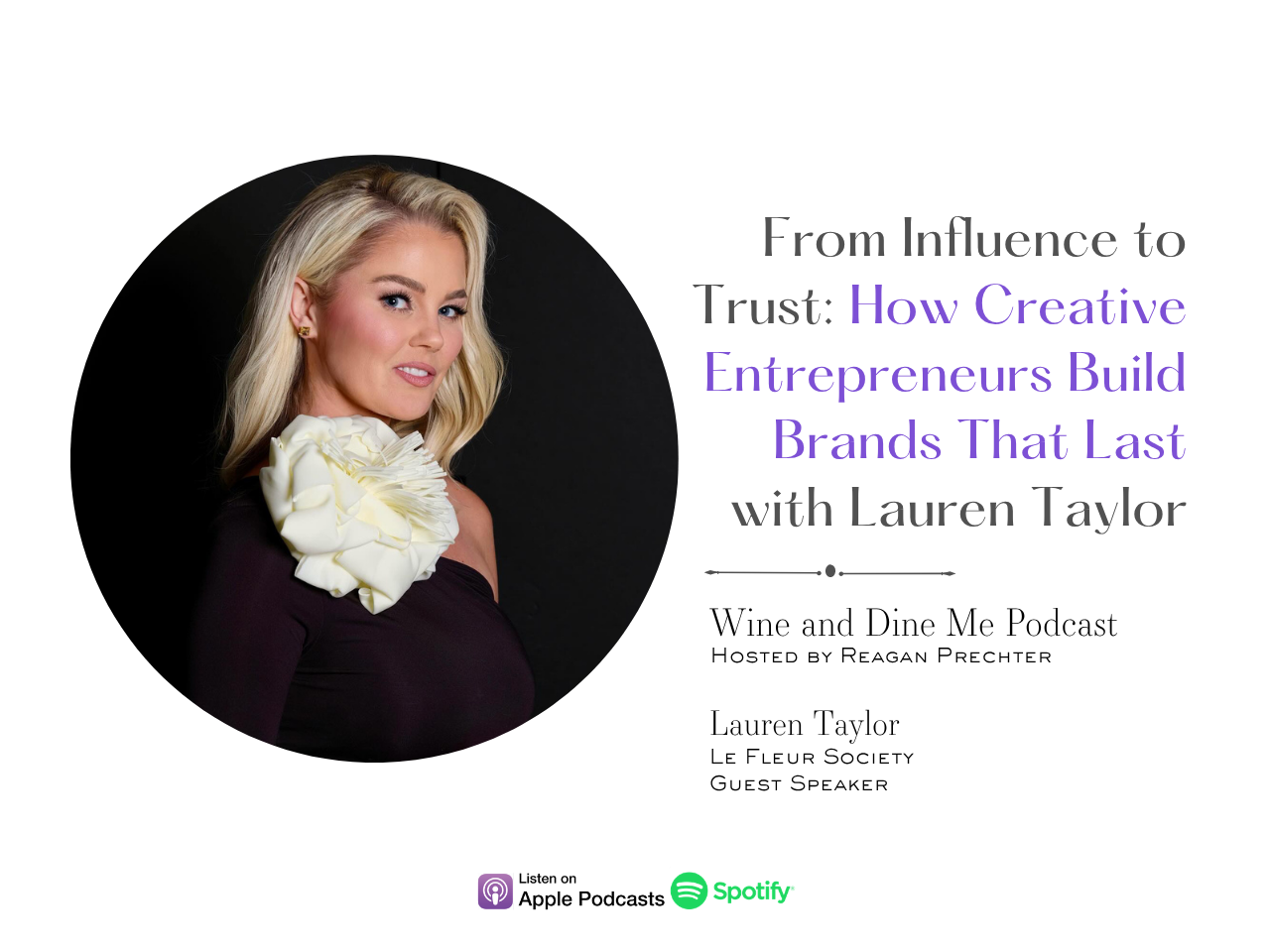
Lauren Taylor’s career has moved through law, entrepreneurship, talent strategy, and brand partnerships, but the throughline is easy to see: she understands what creative people need when their work starts to grow beyond them. Structure. Protection. A point of view. And enough trust to build something that can last.
That thread ran through my conversation with Lauren Taylor, founder of Le Fleur Society and owner of Lauren Taylor Law. Lauren has one of those careers that makes perfect sense once you hear her explain it, even though it would not have been obvious from the outside. She built a law firm first, then stepped into talent representation and brand strategy with the instincts of an attorney, the eye of a marketer, and the protective energy of someone who understands what creative people often fail to protect.
This episode of The Wine and Dine Me Podcast was about branding, yes. But more than that, it was about trust. What earns it. What weakens it. What makes a founder worth following long before someone is ready to buy.
Listen to our full conversation via Spotify or Apple Podcasts.
The founder story is no longer optional
There was a time when a business could hide behind a polished logo, a beautiful website, and a few well-placed testimonials. That is not enough anymore.
Lauren spoke about the growing importance of the founder story, especially for creative entrepreneurs. People do not just want to know what you sell. They want to understand how you think, what you value, what you notice, and how you respond when something does not go according to plan.
That does not mean every private detail belongs online. It does not mean turning your life into content or narrating every emotional inconvenience in real time. It means giving people a sincere point of connection.
For a planner, that may look like showing the decision-making behind a guest experience. For a designer, it may be explaining why one floral direction feels more appropriate than another. For an attorney, it may be showing the care behind a difficult client conversation. For a founder, it may simply be letting people see the standards you return to again and again.
A founder story is not a performance. It is a pattern.
Over time, your audience begins to understand how you move. They learn what you will protect, what you will not compromise, and what kind of experience they can expect from you. That recognition is more valuable than a viral post because it becomes part of your reputation.
Authenticity does not mean exposure
Authenticity has become one of those words that has been used so often it can start to feel hollow. Everyone is being told to “be authentic,” but very few people are defining what that actually means.
Lauren said something I loved: authenticity is felt more than it is described.
That is true in branding, in hospitality, in leadership, and in events. Guests can feel when a dinner has been designed with care versus assembled from a checklist. Clients can feel when a vendor is listening versus waiting to speak. Audiences can feel when a founder is sharing from a grounded place versus posting because a content calendar demanded it.
For sophisticated brands, this matters deeply. There is often a fear that showing more personality will cheapen the brand or make the work feel less elevated. But the answer is not to become messy for the sake of relatability. The answer is to be more human without losing discernment.
You can show process without showing chaos.
You can tell the truth without oversharing.
You can be warm, specific, direct, and still hold a high standard.
That balance is where strong brands are being built now.
Pretty content is not the same as a point of view
We are surrounded by content that looks acceptable. Everyone has access to templates, editing tools, inspiration boards, and the same revolving set of trending sounds. The result is a market full of polished sameness.
Lauren’s perspective was clear: what differentiates a brand now is not just how beautiful the content looks. It is whether there is a reason to come back.
That is where episodic storytelling matters.
Instead of thinking about every post as a one-off, founders should think about the larger thread. What are you teaching people to notice? What series could someone follow? What part of your work naturally creates curiosity?
For Reagan Events, that might be the anatomy of a multi-day wedding weekend. How transportation affects the guest experience. Why pacing matters more than people realize. What happens behind the scenes when a tented event shifts from design concept to installation. These are not gimmicks. They are windows into the level of thought that supports the final experience.
For another founder, it might be product development, client education, contract negotiation, styling decisions, renovation progress, team culture, or the quiet operations behind a beautiful result.
The best content does not simply say, “Look at this.” It gives people a reason to think, “I want to see what happens next.”
Searchability may matter more than being followed
One of the most practical parts of our conversation was Lauren’s take on SEO and discoverability.
For years, businesses treated social media growth as the prize. More followers meant more credibility. More visibility meant more opportunity. But the market has become more discerning, and follower count is not the clean signal it once was.
People can buy followers. Agencies can inflate numbers. Accounts can look larger than they are meaningful. Brands know this. Consumers know this. Platforms know this.
What matters more now is whether the right people can find you when they are actively looking.
That means your website, podcast content, social captions, blog posts, image descriptions, and long-form writing all need to work together. Not in a clunky, keyword-stuffed way. In a way that reflects how real people search, ask questions, and make decisions.
For a Charleston wedding planner, that might mean creating content around multi-day weddings, destination wedding logistics, guest experience, tented event production, or Italy destination wedding planning. For a creative entrepreneur, it might mean writing about your process, your services, your point of view, and the problems your clients are quietly trying to solve.
The goal is not to chase search engines at the expense of voice. The goal is to make your expertise easier to find without flattening the brand.
A beautiful site that no one can find is not doing its job. A searchable site that feels generic is not doing its job either.
The strongest brands will need both.

Your business brand and personal brand should move together
Lauren used an image I found helpful: your business brand and personal brand are like two ships moving in the same direction, but with different crews.
They should be aligned, but they do not need to be identical.
This is where many entrepreneurs make a mistake. They batch one piece of content and push it everywhere. The same caption goes to Instagram, TikTok, LinkedIn, the website, and sometimes even the email list. It may feel efficient, but it rarely respects the way people use those platforms.
Instagram is often more visual and atmosphere-driven. TikTok can hold more immediate, conversational energy. A blog allows for depth and searchability. A podcast creates intimacy and cadence. LinkedIn can carry a sharper business perspective. Email can feel more personal and direct.
The message can be consistent while the expression changes.
That is important because brand consistency is not repetition. It is recognition. People should feel the same underlying standard across every platform, even when the format shifts.
For a founder, the personal brand gives context. It helps people understand the values behind the company. The business brand gives structure. It shows how those values are delivered through service, process, and results.
When both are working, people are not just consuming content. They are building trust before the first inquiry ever happens.
Creative entrepreneurs have to protect what they are building
Because Lauren comes from a legal background, she brings a level of protection to brand strategy that many creatives need more than they realize.
Creators and entrepreneurs are often generous with ideas. We talk through possibilities. We give away direction in early conversations. We want people to understand the value, so we show them a little too much before the agreement is signed.
There is nothing wrong with generosity. In fact, the best creative communities are often built on shared insight, thoughtful referrals, and open conversation. But there is a difference between showing your value and giving away the structure someone should be paying you to create.
This is especially true in partnerships, brand deals, licensing, usage rights, exclusivity clauses, creative concepts, and proprietary process. A contract is not just a formality. It is the document that protects the relationship before memory, assumption, or convenience can distort it.
Lauren talked about creators signing agreements without fully understanding what they are giving away. Usage rights. Exclusivity. Long-term access to content. Restrictions that may not feel significant in the moment but can limit future opportunities.
Creative work may be intuitive, but it still deserves structure.
The more refined the brand, the more important the protection.
Trust is the actual currency
Underneath the entire conversation was one word: trust.
Trust is what makes someone inquire before they have met you. Trust is what allows a client to hand over a milestone and believe you will protect it. Trust is what makes a brand choose one creator over another. Trust is what helps a founder recover when something imperfect happens.
It is not built by saying the right thing once.
It is built through consistency, discretion, clarity, follow-through, and the quiet confidence of knowing what you bring to the table.
Lauren and I also talked about integrity when people leave, copy, compete, or disappoint you. Anyone who has built a business long enough has experienced some version of that. A team member moves on. Someone borrows too closely. A relationship changes. A person you trusted handles something in a way you would not have chosen.
The temptation is to explain, defend, or correct the record. But often, your body of work says more than your reaction ever could.
People notice integrity. They notice restraint. They notice whether your behavior matches the brand you have been building.
Especially for women in business, there is pressure to stay soft but not be naive, direct but not cold, generous but not exposed. There is no perfect formula. But there is value in staying clear. Do the work well. Protect what needs protecting. Keep moving with grace.
The perfect moment is not coming
Toward the end of the episode, I asked Lauren what she would say to the woman who knows she has something to build but is waiting for the perfect moment.
Her answer was direct: it is never going to feel perfect.
That is the truth most entrepreneurs learn eventually. Confidence often comes after the decision, not before it. You build the thing while you are still a little scared. You refine the offer after you begin. You learn the lesson after the first version fails. You find the next level by letting go of the comfort that kept you still.
The dream does not disappear just because you delay it. It waits. Sometimes patiently. Sometimes loudly.
And at some point, the cost of waiting becomes heavier than the risk of beginning.
For creative entrepreneurs, founders, planners, designers, and anyone building a brand with real intention, this conversation was a reminder that longevity is not built from visibility alone. It is built from clarity. Protection. Point of view. Searchability. Trust. And the willingness to pivot without abandoning the deeper reason you started.
The strongest brands are not simply followed.
They are understood.
They are remembered.
They are trusted before the first conversation begins.
Listen to our full conversation via Spotify or Apple Podcasts.